Learn · Updated
What Is MilkDrop? History, Presets and Where to Run It Today
Short answer: MilkDrop is a music visualiser created by Ryan Geiss for Winamp in 2001, whose presets use per-frame and per-pixel equations and a feedback loop to create flowing visuals; today its presets run in MilkDrop 3, BeatDrop, projectM, Butterchurn, Webamp and NestDrop.
MilkDrop is a music visualiser created by Ryan Geiss and first released in 2001 as a plugin for the Winamp media player on Windows. It became the best-known music visualiser of the Winamp era, and its preset format is still used by several active projects.
How MilkDrop works
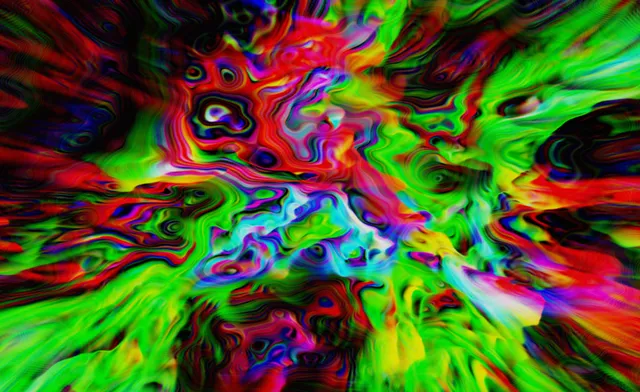
MilkDrop combines simple audio analysis with a feedback loop. Each frame, it takes the previous frame, warps it slightly (zooming, rotating, rippling), blends it with new shapes and waveforms, and draws the result. Repeated many times per second, small distortions accumulate into the flowing, liquid look MilkDrop is known for.
A preset defines the behaviour. Presets are text files (.milk) containing:
- Per-frame equations, run once per frame, that set values such as zoom, rotation and colour, usually based on the current bass, mid and treble levels.
- Per-pixel (per-vertex) equations that vary the warp across the screen, for tunnels, swirls and ripples.
- Custom waves and shapes drawn on top.
- In MilkDrop 2 (2007), pixel shaders for the warp and final composite stages, which greatly expanded what presets could do.
MilkDrop blends smoothly between presets, so a playlist of presets can run for hours without repeating exactly. The community has produced tens of thousands of presets.
Open source and successors
The source code for MilkDrop 1.04 was released under a BSD licence in 2005, and MilkDrop 2.25c followed in 2013. Combined with the enormous preset library, that allowed the format to outlive Winamp itself.
| Project | Platform | What it is |
|---|---|---|
| MilkDrop 3 | Windows | Standalone continuation of MilkDrop 2 that reacts to any system audio |
| BeatDrop | Windows | Open-source standalone build of a customised MilkDrop 2 engine |
| projectM | Linux, macOS, Windows | Cross-platform OpenGL reimplementation and library (LGPL 2.1) |
| Butterchurn | Web | WebGL implementation for browsers (MIT) |
| Webamp | Web | Winamp 2 recreation with a Butterchurn MilkDrop window |
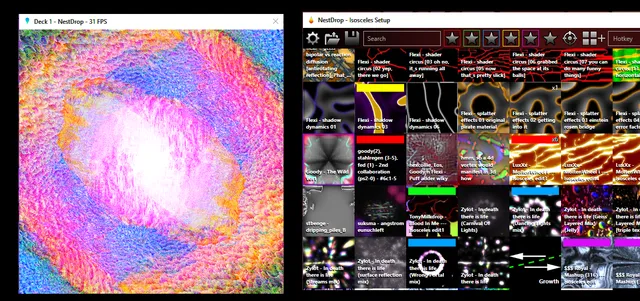
| NestDrop | Windows | MilkDrop engine in a VJ performance interface with Spout output |
Why it still matters
MilkDrop showed that a visualiser could be a programmable art form rather than a fixed effect. Its ideas, such as feedback, per-pixel warping, audio-driven equations and user-shared presets, run through modern generative visual tools, shader communities and VJ software.
To try it today: on Windows, use MilkDrop 3; on any computer, open Butterchurn in a browser; on Linux, install projectM. See all MilkDrop-style visualisers.
Frequently asked questions
Who made MilkDrop?
MilkDrop was created by Ryan Geiss. Version 1.0 was released in 2001 as a plugin for the Winamp media player.
Is MilkDrop open source?
The source code of MilkDrop 1.04 was released under a BSD licence in 2005, and the source of version 2.25c followed in 2013 under the same licence. That release made later projects such as MilkDrop 3 possible.
How do I run MilkDrop on a Mac or Linux?
Use projectM, a cross-platform reimplementation that reads MilkDrop presets, or run MilkDrop presets in a web browser with Butterchurn.